
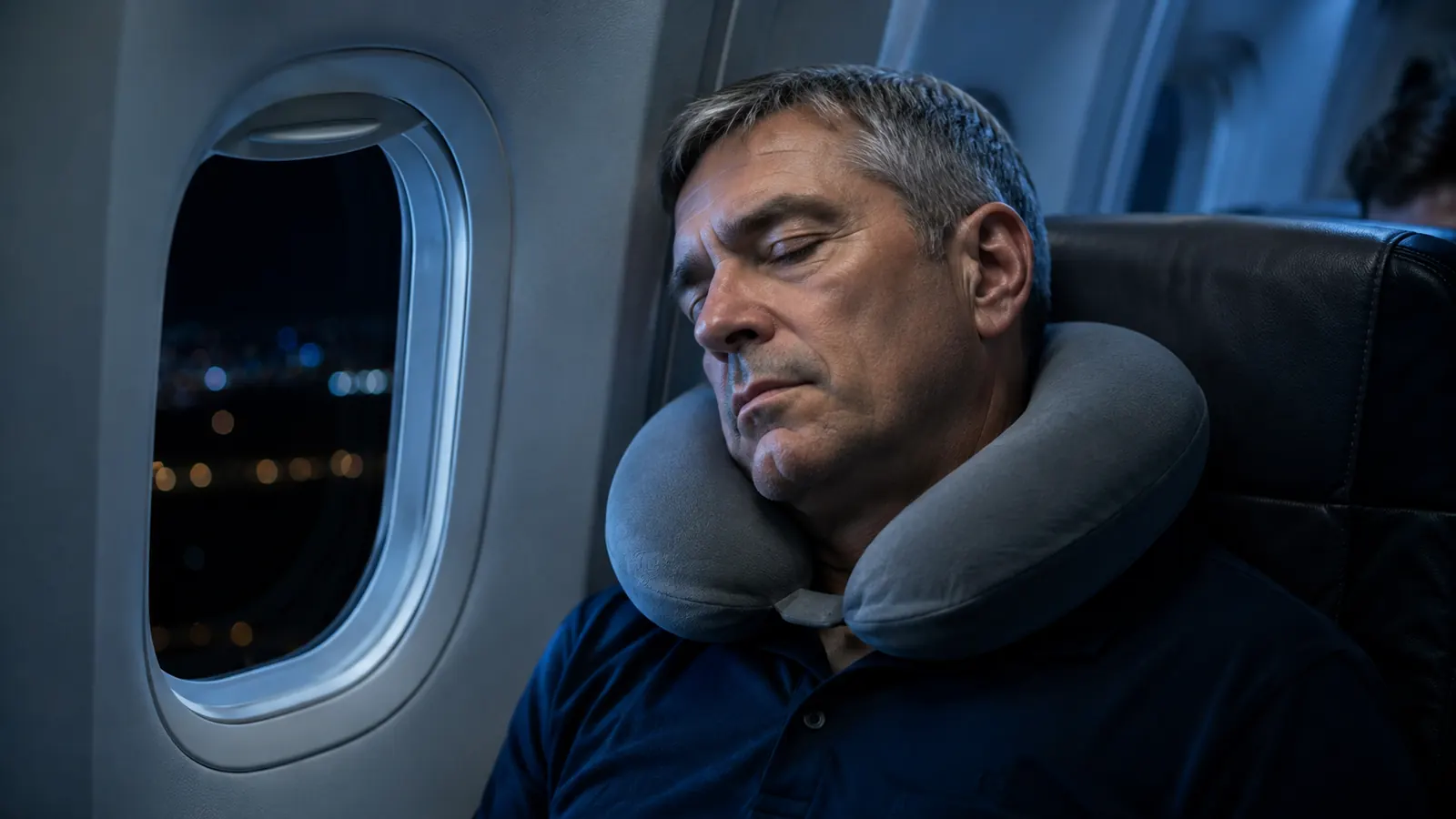
I've flown more red-eyes in the last six months than I care to add up. LAX to Orlando in February, Denver to Newark in April, and one miserable 1 AM connection through Dallas that got delayed twice in May. Somewhere around that Denver trip I got tired of waking up with a neck that felt like it had spent the night in a fender bender, so I bought the MLVOC Airplane Travel Neck Pillow, the memory foam one that comes with a 3D eye mask and a pair of earplugs stuffed into a little drawstring pouch.
Six months and somewhere around forty flights later, here's what I actually think of it. Not a rewrite of the Amazon listing, just what happened when I dragged this thing through airport after airport, stuffed it under a seat, crushed it in a backpack, and asked it to do its one job at 35,000 feet, over and over again.
The Quick Verdict
A genuinely comfortable neck pillow that holds its shape better than the foam pillows I've owned before, with a surprisingly useful eye mask and earplug kit thrown in. It's not perfect for side sleepers or anyone who runs warm, but for the price of what it costs, it earned its spot in my carry-on.
Amazon Check Today's Price →Tired of Waking Up With a Stiff Neck Every Time You Fly?
I was doing the fold-up-jacket trick for years before I finally bought a real neck pillow. Six months of red-eyes later, this is the one still riding in my backpack. Check today's price on Amazon before your next flight.
Amazon Check Today's Price on Amazon →How I've Used It
I didn't buy this for one trip and call it a review. This pillow has flown with me on roughly eighteen round trips since February, mostly work travel with a couple of family trips mixed in, including a nine-hour red-eye to Anchorage in June that I still think about. It's been compressed into a backpack side pocket more times than I can count, clipped to a rolling suitcase handle with the built-in strap, tossed in an overhead bin, and once left on a plane in Charlotte and retrieved from lost and found two days later, still smelling like recycled cabin air but otherwise fine.
I wash the outer cover every few weeks when I'm home for more than a couple days, because six months of headrests and airport carpet is not something I want pressed against my face without a wash cycle in between. The zip-off cover has held up to that without the seams pulling or the fabric pilling, which is more than I can say for a cheaper pillow I owned two years ago that started shedding foam dust by month three.
I kept a rough log on my phone, mostly out of habit from years of tracking mileage and gear on the road. By my count it's ridden in a backpack, a duffel, and clipped to the outside of a rolling carry-on across roughly nineteen different airports, from small regional strips with two gates to O'Hare on a Friday afternoon, which is its own kind of stress test for anything you're carrying.
I also compared it against an inflatable travel pillow I used for a couple years before this one. If you're trying to decide between the two styles, I broke down the tradeoffs in a separate piece: memory foam neck pillow vs inflatable travel pillow. Short version, foam wins on comfort, inflatable wins on packed size, and that tradeoff matters more than most reviews let on.
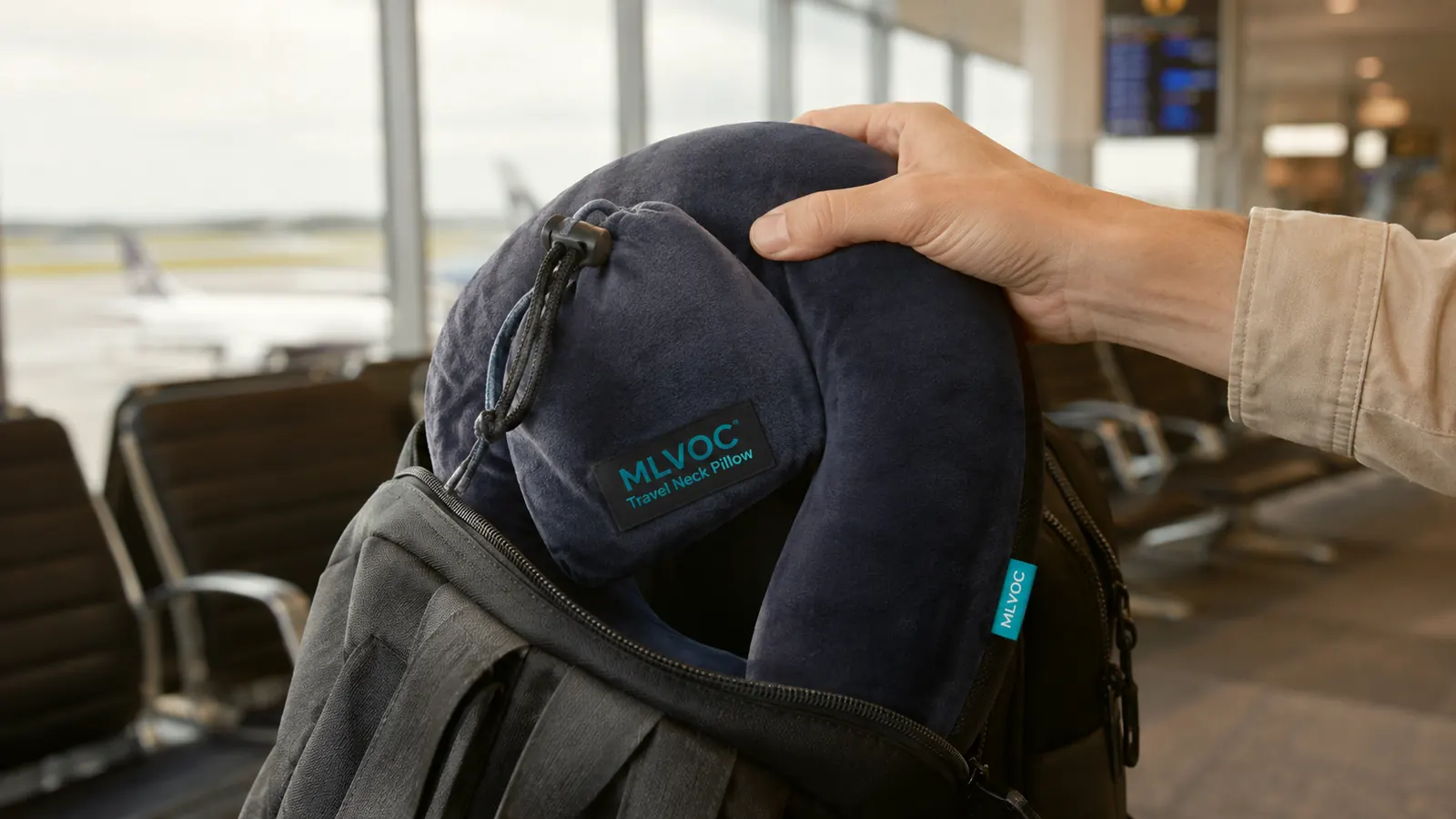
The Memory Foam: Does It Actually Hold Its Shape After Months of Squishing
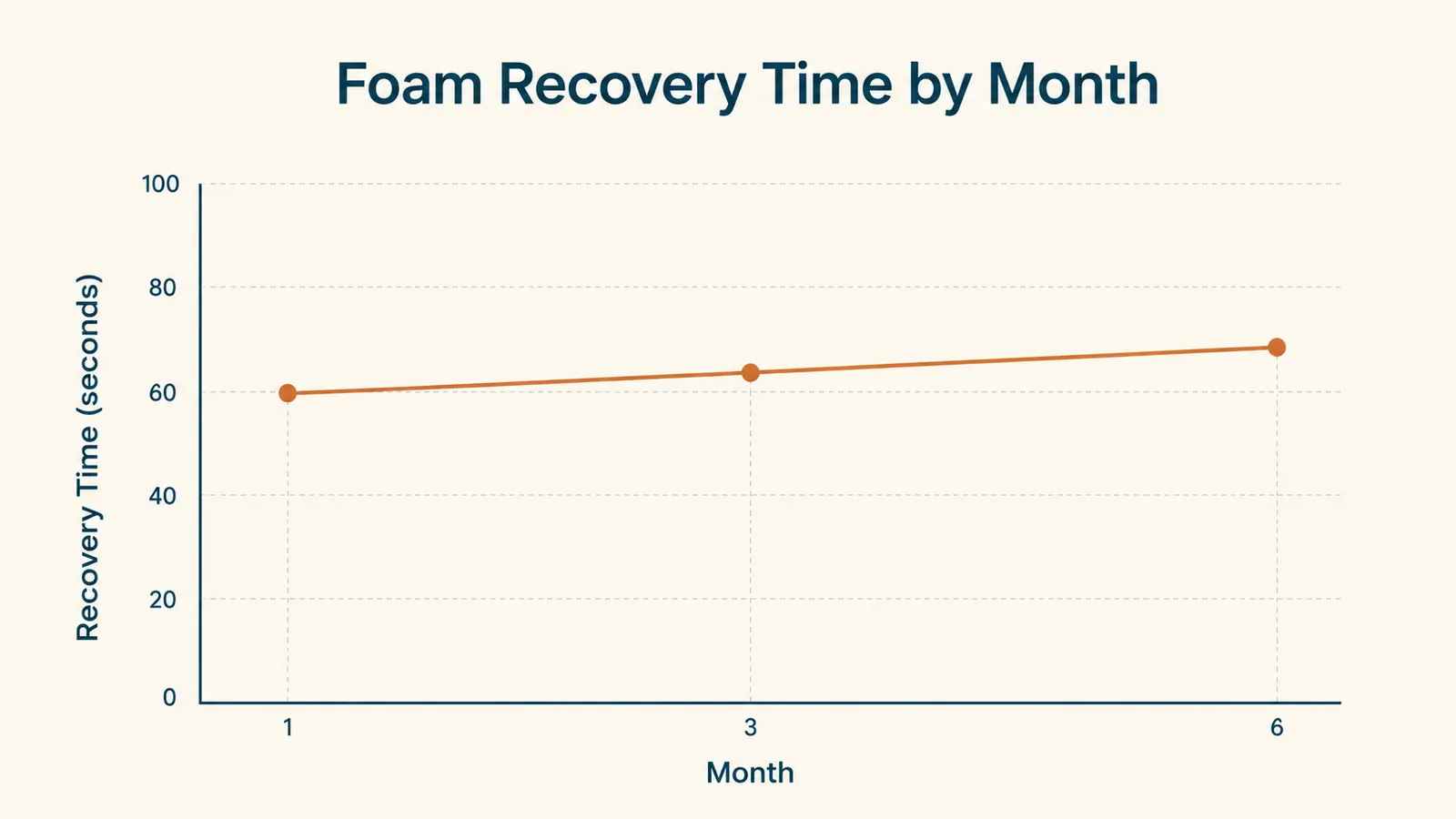
This was my biggest worry going in. Cheap memory foam neck pillows tend to go soft and flat after a few months of being crushed in a bag, and then you're basically resting your head on a fabric loop with no support left in it. Six months in, the MLVOC pillow still springs back. It's not as snappy as it was the first week, there's maybe a beat longer before it fully re-expands after coming out of my backpack, but it hasn't gone flat or lost its curve.
I actually timed the recovery a few times out of curiosity, pressing it flat and watching how long it took to pop back to full shape. Month one it was under ten seconds. By month six it's closer to fifteen, still fast enough that by the time I sit down and buckle in, it's ready. The curve of the pillow, the part that cradles your chin and keeps your head from doing that awful forward nod, is still the same shape it was on day one. That's the part I actually care about, and it's the part that's held up.
The Eye Mask and Earplugs: The Part Nobody Talks About
Most reviews barely mention the eye mask and earplugs that come bundled in, but I've probably used the eye mask more than the pillow itself at this point. It's a 3D contoured design, meaning it doesn't press flat against your eyelids the way a cheap flat mask does, so you can actually blink and it doesn't smear your face or leave lash marks. On that Anchorage red-eye with the sun barely setting that time of year, this eye mask is the reason I got any sleep at all.
The earplugs are foam, nothing fancy, and I've gone through two pairs since February because foam earplugs just wear out and get gross with reuse. That's a normal cost of doing business with any foam earplug, not a knock on this kit specifically. The little drawstring pouch they all come in has started to fray slightly at the seam, but it still does its one job of keeping everything together in my bag instead of loose at the bottom.
Comfort on Actual Red-Eyes: What Six Months of Neck Position Taught Me
I sleep on my back or leaning slightly forward, never fully on my side, and this pillow was built for that. The curved chin support genuinely stops your head from dropping forward once you doze off, which was my whole problem before I bought it. On the Dallas connection, delayed twice and running on maybe four hours of sleep already, I still woke up without the crick in my neck that used to be a guarantee after any flight longer than three hours.
Where it's less impressive is side sleeping against the window. The pillow is built to support your chin and the front of your neck, not to give you a soft wall to lean your temple against. If you're someone who sleeps almost entirely on your side, propped against the window, you may not get the same benefit I did. I've got a friend who flies that way and tried mine on a shared flight to Nashville, and he said it was fine but not the upgrade he was hoping for compared to a rolled-up jacket.
Temperature is the other thing worth mentioning. The foam does trap a little warmth against your neck, more noticeable on a warm-cabin flight than a cold one. I've never had it feel uncomfortable, but if you're someone who runs hot on planes already and sleeps with a scarf pushed off your neck within the first ten minutes, keep that in mind before you buy.
Packability and the Strap System
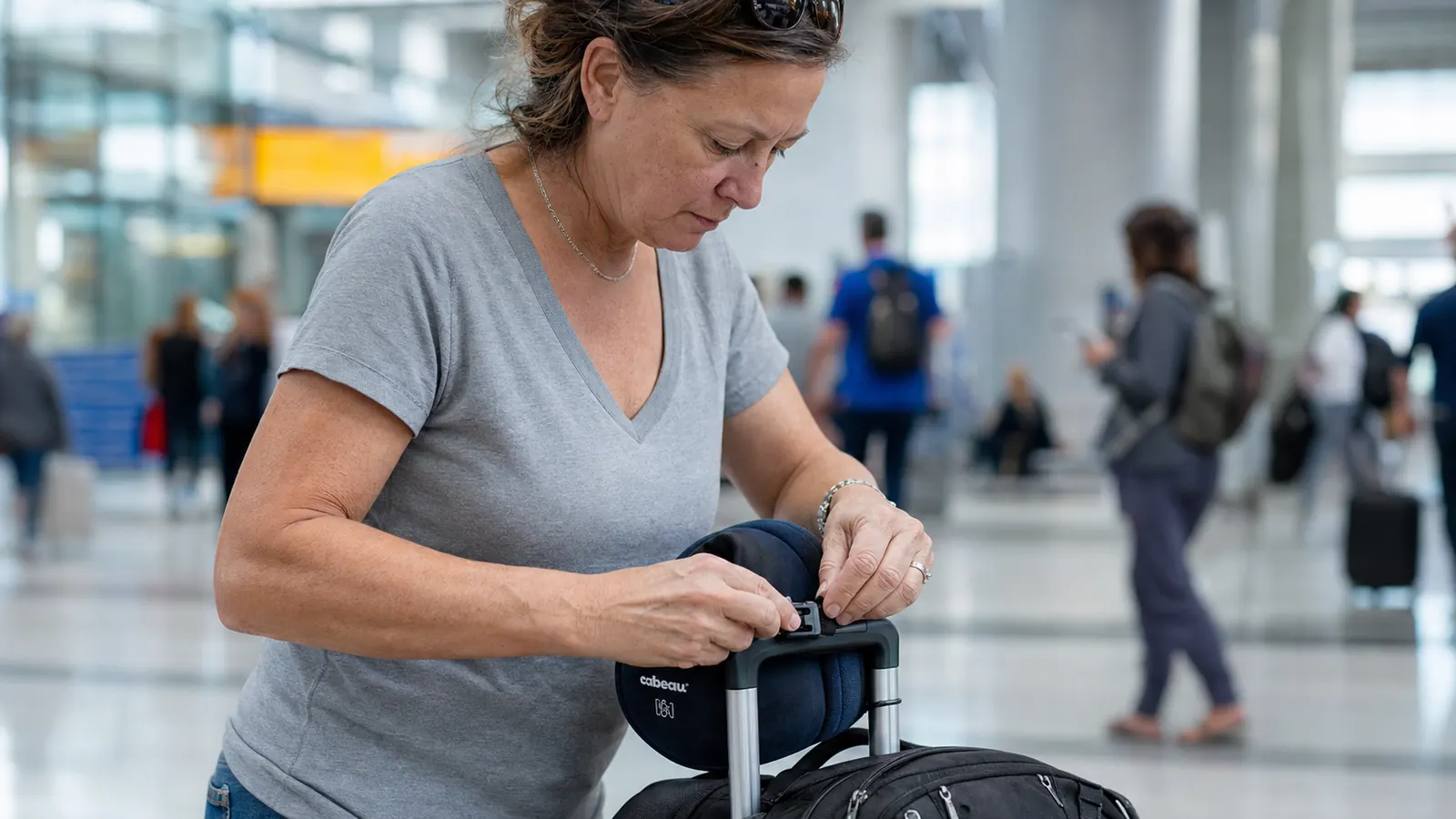
It comes with a small elastic strap meant to compress it down and clip it to a bag, which I use every single trip. Compressed, it's maybe two thirds the size it is fully expanded, small enough to clip onto the outside of a rolling carry-on without eating up interior space I need for clothes or a laptop bag. That strap has stretched slightly over six months of daily clipping and unclipping, but it still holds tight enough that the pillow has never come loose mid-transit.
If you're the type who wants a full packing system dialed in before a trip, not just one pillow, I put together a step by step breakdown here: how to sleep better on long flights. The pillow is one piece of that puzzle, not the whole answer, and that guide covers the rest of it, seat position included.
Value For What It Costs
I've owned two other neck pillows before this one, a cheap gas-station inflatable that lasted maybe four flights before the seam split, and a foam pillow from a big-box store that flattened out within two months. Measured against those, this one has already outlasted both combined, and it's still going. That's the math I actually care about when I'm deciding whether something is worth what it costs, not the sticker price alone but how many flights it survives before I'm back on Amazon buying a replacement.
It's not the cheapest neck pillow on Amazon and it's not the most expensive either. It sits in that middle range where you're paying for the memory foam and the bundled accessories rather than a name brand. Six months in, I'd say the accessories alone, the eye mask especially, would have been worth buying separately at close to what the whole kit costs today, so the pillow itself has essentially come along for free by that math.
Where It Starts to Show Wear
I want to be straight about this, because every gear review that claims zero wear after six months of real use is lying to you. The fabric cover has a small snag near the zipper pull from getting caught on my backpack's carabiner clip back in April. It doesn't affect function, just cosmetics. The velcro closure on the accessory pouch has lost a little of its grip, so I've started just tucking it into a mesh pocket instead of relying on the closure to stay shut in my bag.
The foam itself, as I mentioned, recovers a beat slower than it did on day one. I wouldn't call that a defect, that's just what foam does over hundreds of compression cycles. If you're buying this expecting day-one performance to last forever with zero change, no memory foam product on the market will give you that. What matters is whether the change is gradual and minor or a fast slide into uselessness, and six months in, this one is squarely the former.
What I Liked
- Chin and neck curve genuinely stops the forward head drop on red-eyes
- Memory foam still holds its shape after roughly forty flights
- 3D eye mask is more comfortable than most standalone masks I've owned
- Compresses small enough to clip to a rolling bag without eating interior space
- Washable cover has held up to repeated washing without pilling
Where It Falls Short
- Not built for side sleepers leaning against the window
- Foam earplugs wear out and need replacing every couple months
- Accessory pouch velcro has weakened with daily use
- Foam recovery time slows slightly after months of compression
- Traps a little warmth on flights with a warm cabin
Six months of red-eyes later, the test wasn't whether it felt good out of the box. It was whether it still worked the same on flight number forty as it did on flight number one. Mostly, it did.
Who This Is For
If you're a back or forward sleeper who's tired of waking up with a stiff neck on flights longer than a couple hours, this is a solid pick, especially if you fly red-eyes regularly like I do for work. The eye mask alone makes it worth considering if you've never used a 3D contoured one before. For the deeper dive into which specific problems it solves and doesn't, I wrote a follow-up covering that in more detail: the honest, unfiltered version of this review.
Who Should Skip It
If you sleep almost exclusively on your side against the window, or you run hot and can't tolerate anything covering more of your neck than a thin strap, you'll probably be happier with an inflatable style or a different shape entirely. It's also not a great fit if you want a pillow that packs down flat enough to disappear into a small daypack, since the memory foam, even compressed, takes up more room than an inflatable one does. And if none of this convinces you that a neck pillow is worth the bag space at all, I laid out the case for why it matters in 10 reasons neck pillows help you sleep on flights, along with the story of the flight that finally made me buy one, in the overnight flight that finally convinced me.
Forty Flights In and It's Still the One I Grab First
If your neck is the reason you dread the next red-eye, this is the pillow I keep reaching for after six months of actually using it. Check today's price on Amazon and see the current reviews for yourself.
Amazon Check Today's Price on Amazon →