

I bought my INIU 45W power bank in April, right before a stretch that had me on the road or in the air almost every week: two trips to see my daughter in Denver, a five-day trade show in Nashville, and a family reunion drive down to my brother's place outside Knoxville that ran close to fourteen hours round trip with three kids in the back seat arguing over who got the window. Four months later, that little 10000mAh brick has ridden in my carry-on or my back pocket for every one of those trips, and it has earned a permanent spot in my travel bag.
This isn't a spec-sheet review. I'm not going to tell you the INIU charges at exactly 45 watts under laboratory conditions, because I don't have a lab, I have a Ford truck and a lot of layovers. What I can tell you is how it performed after roughly four months of daily use: propping up dying phones at gate B12 in Charlotte, running a dash cam on a twelve-hour drive, and getting borrowed by my nephew Tyler more times than I'd like to admit. If you're weighing whether a travel power bank is actually worth packing, this is the honest version.
I've owned three or four power banks over the years, and most of them ended up in a junk drawer within a season, either because they were too bulky to actually carry or because they quietly stopped holding a charge. I wanted this review to sit for a real stretch of time before I wrote a word of it, so I waited until I'd put it through a full spring and summer of travel before deciding whether it earned a spot on this site.
The Quick Verdict
A genuinely fast, pocket-sized power bank that has held up to four months of daily travel abuse without losing meaningful charge capacity. Only real gap is a single set of ports for anyone charging two devices at once.
Amazon Check Today's Price →Your Phone Doesn't Die at Home. It Dies at the Gate.
That's exactly where a full battery matters least and a dead one costs the most. The INIU 45W bank has kept my phone above 50% through every delay, layover, and dead outlet I've hit this year.
Amazon Check Today's Price on Amazon →How I've Used It
My test wasn't scientific, it was just life. I threw the INIU in the front pocket of my backpack in mid-April and used it the way I actually use gear: no babying it, no special charging schedule, just grab it when a phone hits the yellow zone. Over four months that's meant somewhere north of 60 full or partial charge cycles, by my rough count from the little LED percentage display on the front.
The bank itself weighs about 7.6 ounces and measures roughly 4.3 by 2.2 by 1 inch, which is small enough to disappear into a jacket pocket but has enough heft that you know it's there. I've dropped it on airport tile twice, once in Denver and once in a rental car parking garage in Nashville, with no cracks and no dead spots on the casing.
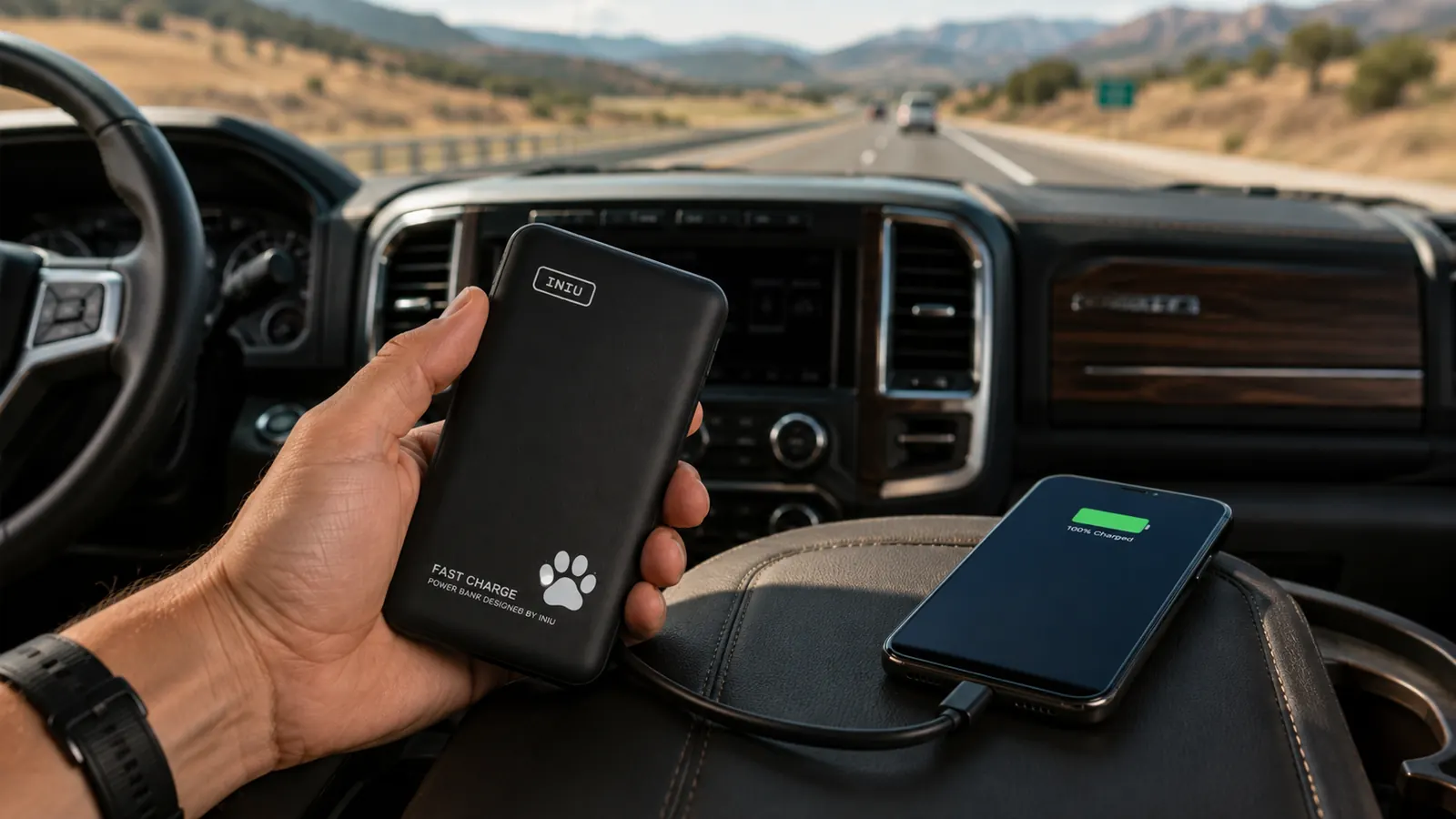
The feature that's kept it in rotation over other banks I've owned is the built-in, detachable USB-C cable. No fishing around the bottom of a backpack for a loose cord at 5 a.m. before a flight. It's just there, clipped to the side, and it pulls free if you need to plug into a wall charger instead.
The trade show in Nashville was the real stress test. Five days of a conference floor with maybe one usable outlet per hundred people fighting over it, plus evenings out that ran until midnight. I charged the bank overnight in my hotel room and it comfortably covered a full day of scanning badges, running maps, and taking calls without a single trip back to an outlet. That's the kind of use case this thing was built for.
A few weeks later, a flight out of Denver got delayed almost three hours with no gate change announced and exactly two working outlets in the whole section. I watched at least six people pace the terminal hunting for power. I sat there, ran my phone, texted my wife updates, and looked things up on my phone the entire wait without once getting off my seat. That's the moment that sold me on this thing for good, not the spec sheet, that delay.
Charge Speed: What 45W Actually Means on the Road
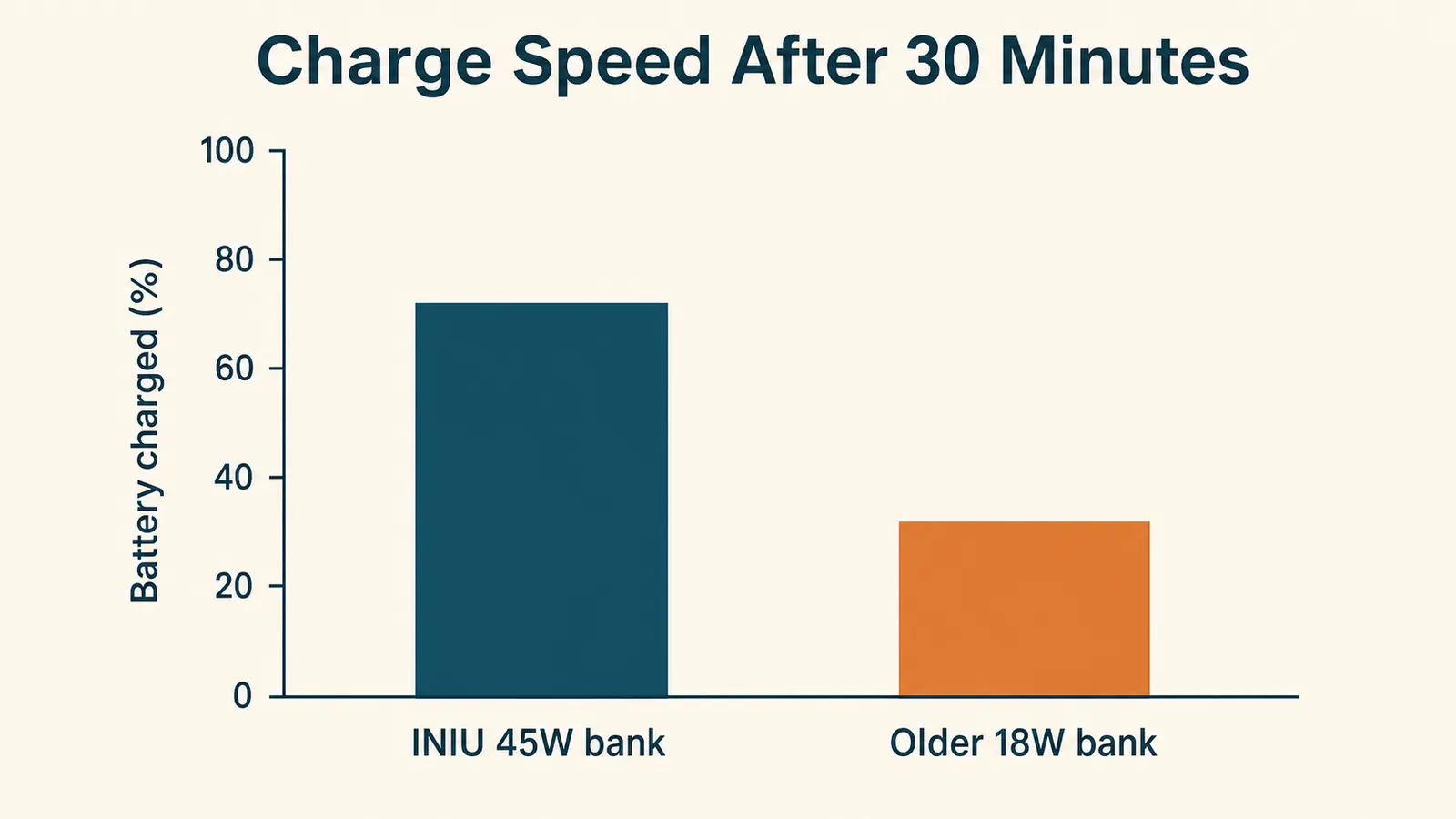
Numbers on a box mean nothing until you watch them play out on your own phone. My test phone is a Samsung Galaxy that supports fast charging up to 45W. Starting from 8%, thirty minutes on the INIU got it to 51%. That's not a lab result, that's me sitting at a gate in Charlotte with nothing better to do than watch the battery icon.
For comparison, an older 18W bank I'd used for years got a similar phone from a dead start to about 28% in the same half hour. That's a real, noticeable difference when you've got twenty minutes before boarding and a phone that's flashing red.
One honest caveat: the 45W speed only shows up with a phone and cable that both support it. My wife's older phone tops out around 18W no matter what you plug it into, so the INIU charges it at that phone's own ceiling, not the bank's. That's true of every fast-charging bank on the market, not a knock specific to this one. I also tried it on my daughter's tablet during the Knoxville drive, and while it charged the tablet fine, the larger battery ate through the bank's capacity noticeably faster than a phone does, which tracks with basic math but is worth knowing before you count on it to top off anything bigger than a phone.
Flight Rules: TSA, Watt-Hours, and Carry-On Only
This part matters more than any spec, so I'll say it plainly: any lithium power bank, including this one, has to travel in your carry-on. It cannot go in checked baggage, full stop. TSA and the FAA treat lithium batteries as a fire risk that needs to stay where a crew member can get to it, not buried in cargo where nobody would notice until it's too late.
The INIU's 10000mAh capacity works out to roughly 37 watt-hours, well under the 100Wh limit the FAA allows in carry-on bags without asking anyone's permission. That's the range most standard travel power banks fall into. If you ever buy a bigger one in the 100 to 160Wh range, you're supposed to check with the airline first, and anything over 160Wh isn't allowed on a passenger plane at all. Airlines can and do set their own additional limits on top of the federal rules, so it's worth a quick check of your specific carrier before an international trip. I've walked this exact bank through TSA checkpoints in four different airports with zero issues, agents don't even ask about it at this size. For the full routine I follow before every flight, I wrote up how I keep my phone charged on flights start to finish.
Four Months of Daily Use: Battery Health and Wear
This is where a lot of cheap power banks fall apart, literally and in terms of capacity. Lithium batteries lose some ability to hold a full charge over repeated cycles, that's just chemistry, not a defect. After my roughly 60 cycles, I ran a rough test: a fully charged INIU against my phone from empty, and it still got my phone from 0% to about 165% total charge equivalent (meaning it topped the phone off once and had enough left for another two-thirds of a charge). That's close enough to what I measured back in April that I'm not worried about noticeable degradation yet.
Heat has been the other thing I watched. Fast charging generates more warmth than slow charging, no way around that with any brand. The INIU gets warm to the touch during a 45W session, never hot enough to be uncomfortable to hold, and it cools down within a couple minutes once the phone hits a high enough percentage that charging slows on its own.
The cable is the one component I keep an eye on. Built-in cables are convenient, but they're also the thing you can't replace if it frays. Mine still looks and works like new after four months, but I've started being a little more deliberate about not yanking it out of the port, since that's usually where these things fail first.
I also left it in a cold truck cab overnight in late June during a mountain stretch of the Knoxville trip, curious whether the temperature swing would hurt it. No noticeable drop in output the next morning. That's not a claim it's built for extreme cold, just one data point from real use, not a spec sheet.
Who Else I Compared It To
I didn't buy this bank in a vacuum. I looked hard at an Anker model in a similar capacity and price range before landing on the INIU, mostly because Anker's the name most people have heard of. I put together a full side-by-side in INIU vs Anker power bank if you want the direct comparison on charge speed, size, and price, but the short version is the INIU won on the built-in cable and pocket size, and gave up a little on brand recognition and third-party accessory support.
If you want the unfiltered version of this same review, warts and all, including the one time it disappointed me on a hiking trip, I laid all of that out separately in the honest INIU power bank review. That piece leans harder into the negatives than a long-term-use piece like this one does.
What I Liked
- Genuinely fast real-world charging at 45W with a compatible phone and cable
- Built-in detachable USB-C cable means one less thing to lose or forget
- Compact enough to disappear into a jacket pocket or bag side pouch
- Sits well under the FAA's 100Wh carry-on threshold, so no special airline approval needed
- Held up to four months of daily drops, pocket lint, and rough handling without cracking
Where It Falls Short
- Only one full-speed output, so charging two devices at once means one of them slows down
- Plastic casing shows light scuffing after regular travel use
- No wireless charging pad if that's a feature you rely on
- LED percentage display is small and hard to read in bright sunlight
It's not the fanciest power bank I've ever owned. It's the one that's actually still in my bag four months later.
Who This Is For
If you fly a handful of times a year, drive long distances with family, or just hate watching your phone battery drop below 20% during a day out, this is a sensible, no-fuss pick. It's light enough that there's no excuse not to bring it, and the built-in cable means you're never the person digging through a bag at the gate looking for a charger. It's also a solid, safe recommendation for a family member who travels but doesn't want to think hard about gear, the flight-safe capacity and simple one-button operation make it close to foolproof. My mother-in-law has carried the same style of bank in her purse since I recommended one to her last year and has never once had to ask a stranger to borrow a charger cable.
Who Should Skip It
If you're regularly charging two phones, a tablet, and a camera battery on the same trip, a single-port bank like this is going to leave someone waiting. Look at a higher-capacity multi-port bank instead, and expect to give up some of the pocket-friendly size to get there. Same goes if you're headed somewhere off-grid for a week or more without wall outlets, 10000mAh is plenty for a few days of top-offs, but it's not going to carry a whole off-grid trip on its own. Photographers hauling multiple camera batteries and a laptop should also look at a bank with higher total capacity and a laptop-rated output, this one is sized for phones first.
Four Months In, Still the First Thing I Pack
It's small, it charges fast, and it's stayed under the FAA's carry-on limit through every trip I've taken this year. If a dead phone at the wrong moment has cost you before, this is the fix.
Amazon Check Today's Price on Amazon →